

AI Music Video Copyright: What Creators Must Know
AI music video copyright is one of the most misunderstood areas for creators in 2026. The short answer: fully AI-generated music currently cannot be copyrighted under US law, but your video can still be monetized on YouTube — if you use the right tools, disclose AI content correctly, and add genuine human creative direction. This guide breaks down exactly what the law says, how YouTube enforces it, and how to build a safe, monetizable AI music video workflow from the ground up.
Key Takeaways
- 100% AI-generated music has no copyright protection under US law — it falls into the public domain, meaning anyone can claim, redistribute, or register it against your own channel.
- Jurisdiction matters: the UK, China, EU, and Japan each treat AI output copyrightability differently. If you distribute internationally, the weakest protection in any territory is your real exposure.
- Your platform license and your creative contribution are your two lines of defense. One without the other still leaves you vulnerable.
- VidMuse's Commercial Use Authorization Agreement grants paid users a worldwide, non-exclusive commercial license over outputs — but it explicitly acknowledges that outputs may not qualify for copyright protection under applicable law. Knowing this distinction is essential.
- YouTube allows AI music in monetized content as of 2026, but requires human creative direction, disclosure, and proof of commercial usage rights. Mass-produced AI audio dumps without meaningful human input are ineligible for ad revenue.
What Is AI Music Video Copyright — and Why Does It Matter Now?
AI music video copyright refers to the overlapping legal questions of ownership, authorship, and usage rights when a music video — its audio, visuals, or both — is generated using artificial intelligence tools.
Three distinct rights layers are in play in any AI music video:
- The music track: who owns the audio, the melody, the lyrics?
- The visuals: who owns the AI-generated footage, avatars, or imagery?
- The combined audiovisual work: the music video as a creative whole.
Each layer is governed by different rules, and in 2026 each remains actively contested in courts and regulatory bodies across multiple jurisdictions. Treating them as a single question leads to the most common mistakes creators make.
This matters in practice because the stakes are no longer hypothetical. YouTube's Content ID system can flag AI-generated audio across millions of uploads simultaneously. A third party can register an AI-generated track — which is technically in the public domain — and automatically claim revenue from every video that uses similar audio. Major record labels have filed significant lawsuits against AI music generation companies over training data, with potential downstream exposure for creators who used those platforms. Understanding where your rights begin and end is a practical, operational concern.
Can AI-Generated Music Be Copyrighted? A Global Legal Overview
Copyright protection for AI-generated music varies significantly by country — and the gap between jurisdictions creates real exposure for creators distributing internationally. Here is the current legal position across major markets.
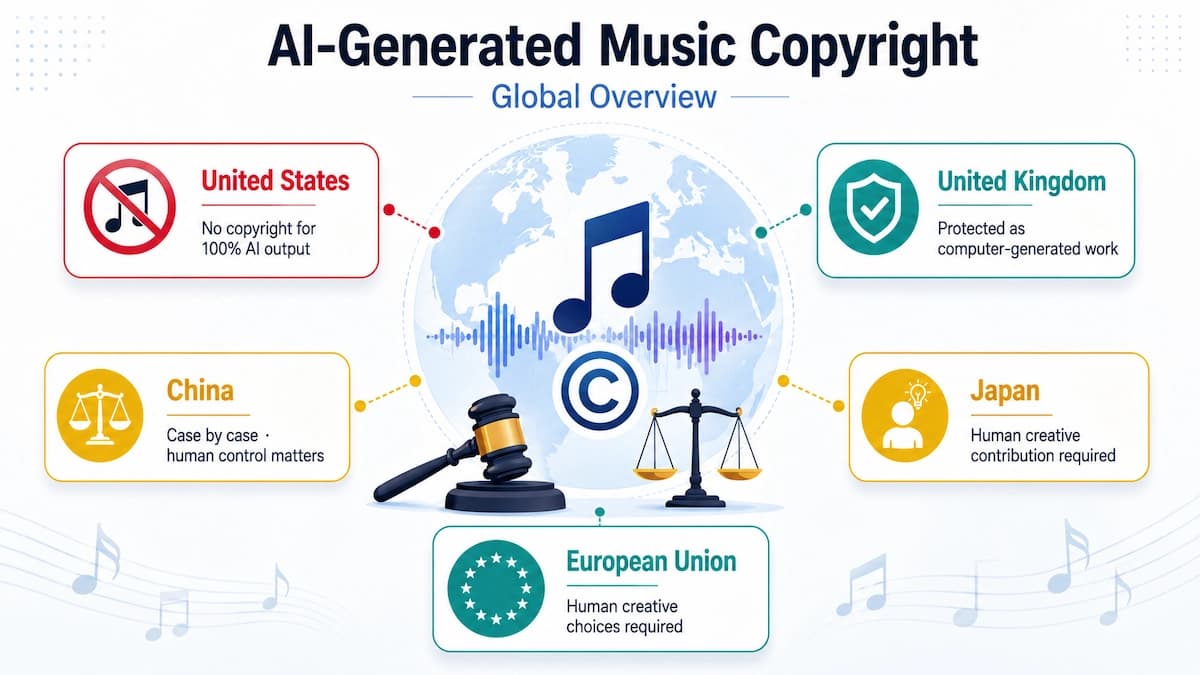
United States: No Copyright for 100% AI Outputs
The US Copyright Office's position is the most stringent. In its Part 2 report published in January 2025, the Office concluded that copyright protection applies to AI outputs only where a human author has contributed "sufficient expressive elements." Writing a prompt — no matter how complex or detailed — does not constitute authorship.
This principle was reinforced in the Thaler v. Perlmutter case, which established that human authorship is a bedrock statutory requirement. In March 2026, the US Supreme Court declined to hear the appeal, allowing the lower court ruling to stand: AI systems cannot hold copyright, and neither can a developer or user merely by prompting the system.
The practical consequence: a 100% AI-generated music track is immediately in the public domain in the United States. No exclusive rights. No legal recourse if someone else uses or claims it.
United Kingdom: Computer-Generated Works Have Protection — For Now
The UK is a meaningful outlier. Under Section 9(3) of the Copyright, Designs and Patents Act 1988, UK law provides copyright protection for works generated by computers where there is no human author. The legal "author" is defined as the person who made the "necessary arrangements" for the creation — which can include the user crafting prompts, the developer, or the funding organization.
The protection is narrower than standard copyright: 50 years from creation rather than life-plus-70, and it carries no moral rights. The UK Intellectual Property Office has also been consulting on potentially removing this protection entirely, with a government review ongoing. Creators distributing into UK markets currently have more protection than in the US — but that position may change.
China: Case-by-Case, Based on Degree of Human Control
Chinese courts have produced the most nuanced body of case law. Rather than applying a blanket rule, courts evaluate the degree of real human control over the AI's output.
In the 2023 Li v. Liu case, the Beijing Internet Court recognized copyright in an AI-generated image where the plaintiff demonstrated continuous iterative prompt refinement, parameter adjustments, and deliberate selection — enough to constitute "personalized expression." In a contrasting 2025 ruling from the Suzhou Intermediate People's Court, a court denied protection where simple prompt inputs were found insufficient to override the AI's inherent randomness. The court specified that copyright requires detailed production logs proving identifiable human intellectual contributions to the layout, composition, and output.
For creators distributing into China: documentation of your iterative creative process is not optional — it is the difference between owning and not owning the work.
Japan: Autonomous AI Outputs Cannot Be Copyrighted
In May 2024, Japan's Agency for Cultural Affairs finalized its General Understanding on AI and Copyright. Fully autonomous AI outputs cannot be copyrighted. To achieve protection, the output must exhibit both "creative intent" and "creative contribution" from a human using the tool. Standard copyright infringement analysis — including market substitutability — applies equally to AI-assisted and human works.
European Union: The "Intellectual Creation" Threshold
The EU AI Act establishes mandatory transparency obligations — platforms must label AI outputs and disclose copyrighted training data — but the copyrightability of outputs relies on existing case law from the Court of Justice of the EU. For protection, an output must be the "author's own intellectual creation," meaning the human user must have exercised "free and creative choices" throughout the generation process. Purely automated outputs from minimal prompts are unprotectable.
Summary table:
- United States — No copyright for 100% AI output; human expressive input required
- United Kingdom — Yes, as "computer-generated work"; 50-year term, no moral rights; under review
- China — Case-by-case; iterative human control and production logs required
- Japan — No for fully autonomous output; creative intent and contribution required
- European Union — No for automated output; "free and creative choices" threshold required
Can You Copyright an AI-Generated Song in The US?
The US Copyright Office's position is clear: 100% AI-generated music cannot be copyrighted. In its Part 2 report published in January 2025, the Copyright Office concluded that copyright protection for AI outputs applies only where a human author has contributed "sufficient expressive elements."
Writing a prompt — even a detailed, carefully crafted one — does not constitute authorship for copyright purposes. The Thaler v. Perlmutter case reinforced this principle: copyright protection is reserved for works of human creation, not machine output.
This has a critical practical consequence: if your music is 100% AI-generated with no human creative input beyond the prompt, the track enters the public domain. Anyone can legally copy, redistribute, or register it — including malicious actors who could then file Content ID claims against your own videos.
What can be copyrighted?
- Lyrics you wrote, even if the music was AI-generated
- Specific vocal performances you contributed
- Arrangement decisions, editing choices, and sequencing you made
- The overall music video if it reflects sufficient human creative expression
The more human creative input layers into the final work, the stronger your copyright claim becomes. AI tools are not the enemy of ownership — but using them passively, without meaningful authorship, is.
Is AI Music Copyrighted on YouTube?
YouTube allows AI music in monetized content as of 2026 — but with conditions that matter significantly for creators. Following a July 2025 policy update, YouTube requires creators to satisfy five overlapping requirements for AI music to remain monetizable:
- Disclosure: Creators must label content when AI tools generated elements that could mislead viewers into thinking they are real. For stylized AI music, the label carries no penalty on reach or monetization. For AI vocals that closely mimic a specific real person, disclosure is required.
- Human creative direction: Content produced through mass-automated generation with no original human input is ineligible for ad revenue. YouTube distinguishes between AI-assisted creative work and content farms uploading raw AI dumps at volume.
- Copyright proof: Tracks must not rely on unlicensed training data that third parties could claim. If a music label's lawsuit succeeds against an AI platform, that could expose outputs from that platform to downstream claims.
- No unauthorized voice cloning: Using AI to replicate a specific artist's voice without that artist's permission violates YouTube policy. Artists who have explicitly licensed their voices for AI use are exceptions.
- Authentic content: Channels operating as automated upload factories face demonetization regardless of individual track quality.
Content ID is the practical enforcement layer. YouTube's Content ID system has expanded well beyond simple waveform matching. It now uses AI pattern recognition capable of detecting shared underlying musical structures across millions of uploads — melodic contours, harmonic progressions, rhythmic patterns — even between tracks that are not identical copies. When thousands of creators use the same AI tool with similar prompts, the outputs share structural patterns that Content ID can flag. This is not speculative: it is the operational reality of using popular AI music generation tools at scale.
The safest position: hold explicit commercial usage rights from your AI platform, add documented human creative direction, and disclose clearly.
AI Music Copyright Infringement: Real Risks That Are Already Happening
AI music copyright infringement is not a theoretical future risk — it is an active, operational problem with three distinct vectors.
Training data liability: Major record labels have filed large-scale lawsuits against AI music generation companies, arguing that their models were trained on copyrighted recordings without permission or compensation. If courts rule in the labels' favor, outputs from those platforms could face sweeping retrospective exposure — for both the AI companies and, potentially, for creators who used those platforms. This risk is not resolved and is actively being litigated.
Third-party Content ID registration: Because 100% AI-generated music is in the public domain in the United States, any party can upload it, register it with Content ID services, and then automatically receive revenue from every video that uses audio with similar patterns — including your own video, even if you generated the track yourself. This is not a loophole or a hypothetical: it is a known abuse vector that is difficult to resolve through YouTube's dispute process.
Ownership gap in platform terms: Many AI music platforms advertise "ownership" of generated tracks while simultaneously acknowledging in their terms that copyright may not vest. These are legally distinct concepts. Owning a file (in the sense the platform grants you a license to use it) is not the same as holding copyright in the underlying work. Creators who do not read this distinction closely are routinely surprised by it when disputes arise.
Voice likeness claims: Using AI to produce vocals that closely resemble a specific real artist — even without directly cloning audio files — creates right-of-publicity exposure in jurisdictions that treat voice likeness as a protected personal asset.
Platform-level enforcement beyond YouTube: The broader distribution ecosystem has tightened. Major streaming platforms removed tens of millions of AI-generated tracks in 2025 for inauthentic content and spam. Distribution services have added AI detection and have their own rules about what qualifies for distribution, separate from YouTube's policies.
Can You Copyright an AI Song If You Wrote the Lyrics?
Yes — human-authored lyrics are independently copyrightable, even when the music is fully AI-generated. This is one of the most practically important distinctions for independent musicians.
Under US copyright law, authorship attaches to the human-created elements of a work. If you wrote the lyrics, you hold copyright in those lyrics. If you arranged and edited the musical output, contributed a vocal performance, or made meaningful compositional decisions that shaped the final track, those contributions create additional human-authored elements that are protectable.
The resulting track is a composite: the lyrics are protected; the AI-generated melody may not be. This is not a perfect outcome — the AI-generated elements remain in the public domain — but it is meaningfully better than having no protection at all, and it gives you a defensible legal interest in the work.
Practical steps:
- Write your lyrics independently and keep dated documentation of that process.
- Register your lyrics as a literary work with the US Copyright Office — this can be done independently of the music.
- When submitting to platforms, assert your human-authored contributions explicitly alongside any AI disclosure.
- Document your arrangement and editing decisions — these are evidence of authorship even when the underlying audio is AI-generated.
In China's legal framework, this principle is extended further: detailed production logs showing iterative human decisions have been sufficient to establish copyright in the whole work. The more thoroughly you document your creative process, the stronger your position in any jurisdiction.
What VidMuse's Commercial License Actually Covers
VidMuse's Commercial Use Authorization Agreement grants paid users a meaningful commercial license — but it also contains specific limitations that creators need to understand clearly.
Create Your AI Video in Minutes
Turn your idea into a video with VidMuse.
Under Article 1 of the Agreement, VidMuse (operated by SandAI) grants paid users a worldwide, non-exclusive, non-transferable commercial use license to generate audiovisual outputs and use them for commercial purposes. SandAI explicitly does not claim ownership over outputs generated by paid users.
What the license permits:
- Online video distribution and monetization, including YouTube
- Music platform visuals (such as Spotify Canvas)
- Advertising, marketing, and brand promotion
- Media broadcasting and production
- Other lawful commercial activities
No attribution to VidMuse is required, though voluntary credit ("Generated with VidMuse") is encouraged.
What the license does not do:
- It does not guarantee copyright protection. Article 1.5 explicitly states that "outputs may not be unique or eligible for copyright protection" due to the nature of generative AI. This mirrors the US Copyright Office's position and is not a loophole — it is an honest acknowledgment of current law.
- It does not extend to free plan users. Article 2.6 is unambiguous: commercial use rights apply only to paid subscribers. Outputs generated under free plans are for non-commercial use only and may include watermarks.
- It does not protect uses that infringe third-party rights. Article 2.4 lists prohibited uses including content that infringes intellectual property rights, portrait rights, privacy rights, or the rights of identifiable real people.
- It does not make SandAI responsible for disputes. Under Article 7, customers bear full responsibility for third-party claims arising from their use of outputs and must indemnify SandAI.
The key practical insight: VidMuse's commercial license gives you the platform's authorization to use outputs commercially — which is the first line of defense in a YouTube monetization dispute or platform compliance check. But it does not create copyright in those outputs, which is a separate and additional layer of protection that only comes from your own human creative contribution. You need both.
How to Build a Copyright-Safe AI Music Video Workflow
A copyright-safe AI music video workflow combines platform licensing, documented human authorship, and platform compliance practices at every stage. Here is a practical step-by-step process.
Step 1: Confirm Your Commercial License
Before generating any content you intend to monetize, verify three things about every AI tool you use — audio and video:
- Does the platform explicitly grant commercial use rights? (For VidMuse: yes, for paid subscribers under the Commercial Use Authorization Agreement)
- Does the license cover YouTube monetization specifically? (For VidMuse: yes, Article 2.5 lists online video monetization explicitly)
- Does the platform acknowledge copyright limitations honestly? (VidMuse does — Article 1.5 — which is more transparent than platforms that claim copyright without qualification)
If a platform cannot confirm explicit commercial usage rights, do not publish monetized content using its outputs.
Step 2: Contribute Human Authorship
At minimum, add one of the following to every project:
- Original lyrics you wrote yourself (independently copyrightable regardless of the AI music)
- A vocal performance you recorded and contributed to the track
- Meaningful arrangement, mixing, or editing decisions that shaped the final audio
- A structured creative brief that drove specific directorial decisions in the visuals
Document these contributions at the time you make them. Screenshots, dated drafts, version histories, and written notes all serve as evidence of authorship.
Step 3: Use a Structured Visual Production Workflow
A music video that reflects a deliberate storyboard, defined shot selection, and a coherent narrative arc demonstrates human directorial authorship in the audiovisual work as a whole — not just in the audio component. This is the difference between an AI-generated output and a human-directed creative work that used AI tools. Courts in China, the EU, and the US all look for evidence of iterative human creative decisions. A structured production workflow generates that evidence naturally.
Step 4: Disclose AI Use on YouTube
Add the AI content label on YouTube when AI-generated elements could mislead viewers into thinking content is real. For stylized AI music, this is best practice even when not strictly required — it carries no penalty and protects you if YouTube's enforcement criteria change. For AI vocals that resemble a specific real person, disclosure is required.
Step 5: Keep Documentation
Maintain records of: your creative brief, your prompts, your editing decisions, your platform license terms, and the dates of each step. In a Content ID dispute or a platform compliance review, documentation of your original creative process is your most valuable asset.
Using VidMuse Features to Layer Human Authorship
VidMuse's agent-based production workflow is structured to generate the kind of documented human creative direction that strengthens your authorship position — not as a compliance workaround, but as the core of how the platform works.
Rather than executing single prompts with no creative architecture, VidMuse guides creators through five stages: Creative Brief → Reference Generation → Scene and Shots List → Storyboard → Video Generation. Each stage requires directorial decisions about mood, pacing, narrative structure, visual language, and shot composition. Those decisions are documented in your project and constitute human creative authorship in the audiovisual work.
Specific features that support copyright-safe production:
- Shot Refine by Quoting (VidMuse 2.0): Enables precise human direction over individual shots — replacing accidental outputs with intentional ones. Shot-level creative decision-making is among the strongest forms of documented authorship a creator can demonstrate.
- Asset Library and Memory: Maintains your approved creative assets across a project, creating a record of consistent creative choices that reflect a coherent human vision.
- Suno AI integration: Allows you to generate music and build visuals within a unified workflow. Crucially, it keeps your music creation and lyric writing within the same documented project — so your human contributions to the audio are part of your project record.
- Timeline Editor: Manual editorial decisions in the timeline — what to cut, what to hold, how to sequence — are forms of human authorship in the audiovisual work. Using the timeline editor creates a record of those choices.
- Template types: Story MV, Abstract MV, Performance MV, Viral Short, TVC, and Explainer templates each require narrative planning and visual direction — the kind of structured creative input that distinguishes a directed work from a raw AI output.
VidMuse's Studio mode, which supports models including Seedance 2.0 Pro, Kling V3.0 Pro, Veo 3.1, and others, applies the same principle to visual generation: the storyboard and shot decisions you make before generation determine whether the final work reflects human authorship or simply machine output.
The VidMuse platform does not replace the need to understand the copyright limitations in its own Commercial Use Authorization Agreement. But it creates a production environment where human creative direction is built into the process at every stage — which is exactly what copyright law, in every jurisdiction reviewed above, is looking for.
Common Mistakes That Lead to Copyright Claims
Most AI music video copyright problems are preventable. Here are the mistakes that most commonly result in Content ID claims, demonetization, or worse.
- Using AI music without verifying commercial licensing terms. Generating a track does not automatically grant you commercial usage rights. VidMuse's commercial license is explicit and well-defined; many other platforms are not. Always read the terms before monetizing.
- Assuming "copyright-free" and "safe to monetize" mean the same thing. Public domain content has no copyright — which means no one can stop others from using or claiming it. Content that is copyright-free offers zero exclusive protection for your channel.
- Prompting with real artist names. Prompts referencing specific artists can produce outputs that closely resemble those artists' work and may trigger claims from their labels or rights holders. Keep prompts style-general rather than artist-specific.
- Using AI vocals that imitate a specific person. Voice likeness is a protected right in many jurisdictions, and YouTube requires disclosure when AI vocals could be mistaken for a real person. Failing to disclose can result in removal.
- Skipping documentation of your creative process. If a Content ID dispute or platform review arises, "I used [tool] to generate this" is not sufficient. You need evidence of what creative decisions you made and when.
- Uploading the same output as many other creators. Content ID's pattern recognition detects shared underlying structures across similar AI outputs, not just identical audio files. Unique production choices — starting with a strong creative brief — reduce this risk materially.
- Treating free plan outputs as commercial content. VidMuse's Commercial Use Authorization Agreement is explicit: commercial rights apply only to paid subscribers. Outputs from free plans are for non-commercial use only.
FAQ: AI Music Video Copyright
Is AI music video copyright-free?
Not in the way most creators assume. AI-generated music falls into the public domain under current US law, which means no one — including the creator — automatically holds copyright over it. "Copyright-free" and "safe to monetize commercially" are not the same thing: content in the public domain can be used, copied, or registered by anyone, including bad actors who could then file Content ID claims against your channel. The safer position is to hold explicit commercial licensing rights from your AI platform and layer human authorship onto your work to build protectable creative ownership.
Is AI music copyrighted on YouTube?
YouTube does not block AI music, but enforces copyright claims regardless of how music was created. Since the July 2025 policy update, YouTube requires human creative direction and disclosure for AI music in monetized content — purely automated AI output with no original human input is ineligible for ad revenue. Content ID's pattern recognition can also flag AI-generated audio that shares underlying structures with other uploads, even without being an exact copy.
Can AI music video copyright infringement happen even if I didn't copy anything?
Yes, through two distinct mechanisms. First, your AI tool's training data may include copyrighted material that rights holders are actively suing to reclaim — exposing outputs from that platform to downstream legal risk. Second, a third party can register your AI-generated output with Content ID (which is technically legal since the output is in the public domain) and then automatically claim revenue from any video using similar audio — including your own. Neither requires you to have deliberately copied anything.
Can you copyright an AI song if you wrote the lyrics?
Yes. Human-authored lyrics are independently copyrightable even when the underlying music is AI-generated. Under US law, copyright attaches to the human-authored elements of a work. Your lyrics are protectable; the AI-generated melody on its own may not be. Register your lyrics separately with the US Copyright Office, document your writing process, and assert your human authorship explicitly when submitting to platforms. In China, detailed production logs demonstrating iterative human contribution have been sufficient to establish copyright in the complete work.
What does VidMuse's commercial license actually cover?
VidMuse's Commercial Use Authorization Agreement grants paid users a worldwide, non-exclusive commercial license to use generated outputs for monetization, advertising, brand promotion, and media production. It explicitly covers YouTube monetization. However, it also clearly states that outputs may not qualify for copyright protection under applicable law — holding this license means you have VidMuse's authorization to use the content commercially, not that you hold copyright in the content. Both your platform license and your own human creative contribution are necessary for a fully protected position.
Do I need to disclose AI-generated music on YouTube?
YouTube's current policy requires disclosure when AI-generated content could mislead viewers into thinking it is real. For stylized AI music where no deception is implied, disclosure is best practice but not always required — and it carries no penalty on reach or monetization. For AI-generated vocals that closely resemble a specific real person, disclosure is required. Failing to disclose when required can result in content removal or channel penalties.
What happens if my AI music video gets a copyright claim?
You have the right to dispute the claim through YouTube's Content ID dispute process. To succeed, you need to demonstrate that you hold commercial usage rights to the content — your platform's license agreement, documentation of your creative process, and evidence that the claim is invalid. Proactive documentation of your creative workflow and your platform license terms is your strongest protection against disputes. If the claiming party registered content they do not legitimately own, YouTube's dispute process can resolve this — but it takes time.
Final Words
AI music video copyright in 2026 presents a layered, jurisdiction-dependent legal landscape — but it is navigable with the right information and workflow. The core principle is consistent across every major legal system reviewed above: passive AI output generation produces no copyright protection. Human creative direction, documented at the time of creation, is what builds ownership.
For VidMuse users specifically, the picture is concrete: the Commercial Use Authorization Agreement gives paid users a clear, worldwide license to monetize outputs across YouTube, streaming platforms, advertising, and brand work. What it does not — and honestly, cannot — guarantee is copyright protection in those outputs. That protection comes from your lyrics, your directorial choices, your timeline edits, and the documented creative decisions you make at every stage of your project.
YouTube's framework reflects the same logic: disclosure, human creative direction, and verified usage rights are the three pillars of a sustainable, monetizable AI music video channel. The platform opportunity is real. Studio-level music video production is now accessible to independent artists using tools available directly through VidMuse AI — from the integrated Suno AI music workflow to video generation models like Seedance 2.0, Wan 2.7, and Happy Horse 1.0. Build that opportunity on a process that protects your work.
Start your first AI music video with VidMuse's AI music video generator. Follow the five-stage workflow. Write your lyrics. Document your choices. And review the Commercial Use Authorization Agreement before you publish.
Disclaimer: This article is for informational purposes only and does not constitute legal advice. Copyright law varies by jurisdiction and is actively evolving. Consult a qualified intellectual property attorney for advice specific to your situation.
Create Your AI Video in Minutes
Turn your idea into a video with VidMuse.

Written By
VidMuse Team
Continue Reading
Latest blog posts related to AI video creation.
Free Music Visualizer: 10 Best Free Tools in 2026
Compare 10 best free music visualizers in 2026. Waveform tools, AI music video makers, watermark policies, export limits, and which tool fits your workflow.
How to Make Product Video Ads with AI (Step-by-Step)
Learn how to make product video ads with AI step by step. Full 6-phase VidMuse tutorial, input tips, ad type guide, and alternative approaches compared.
Best AI Clone Video Generator 2026: 7 Tools Compared
Compare the 7 best AI clone video generators in 2026. Avatar clones, viral ad clones, pricing, features, and how to pick the right tool for your workflow.