

FLUX 3: What It Is, Capabilities, and How to Access It
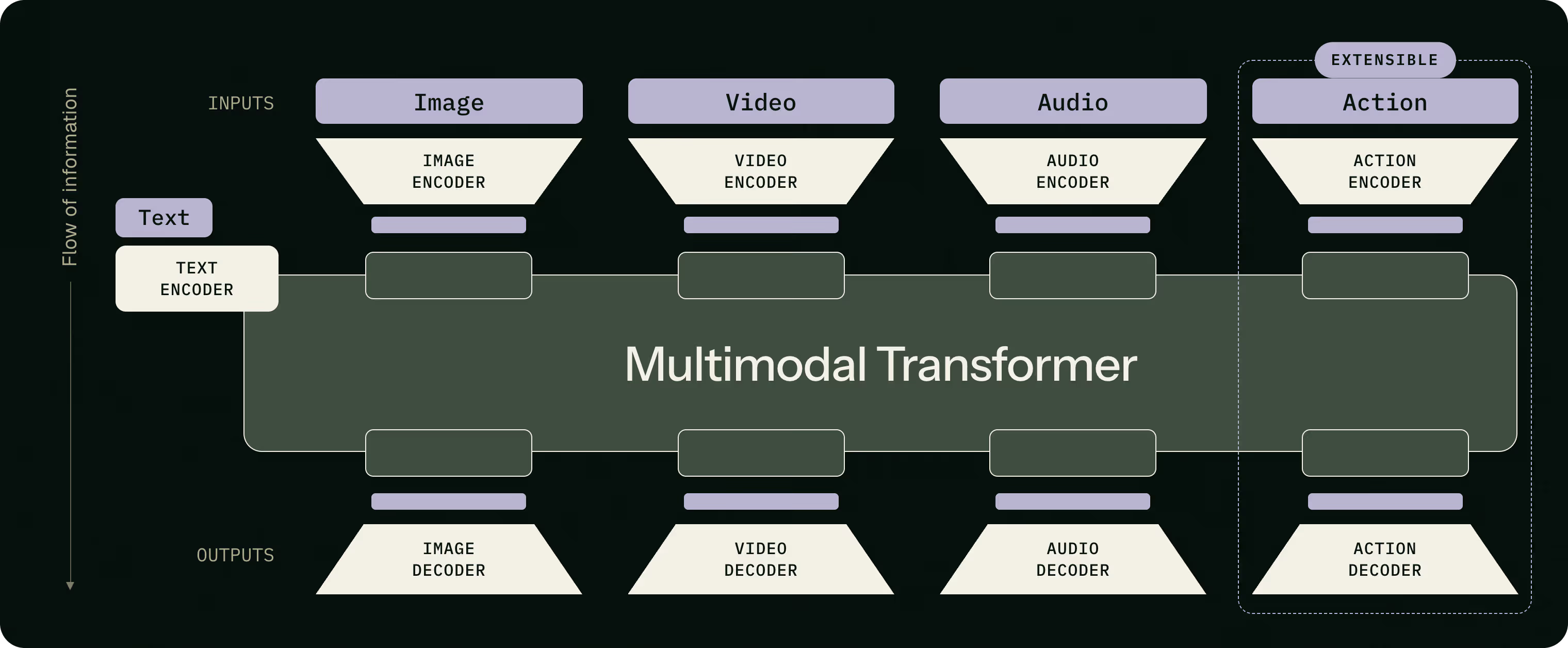
FLUX 3 is Black Forest Labs' multimodal AI model that generates images, video with native audio (up to 20 seconds), and action predictions — all from a single unified network. Launched on July 23, 2026, it is the first FLUX model to go beyond image generation. Built on the Self-Flow architecture, FLUX 3 learns from images, video, and audio simultaneously to build one representation of the world — where objects hold together, things move, and events sound. Video early access is open now at bfl.ai/models/flux-3.
This guide covers what FLUX 3 is, its four modalities, detailed capabilities, how it compares to FLUX 2 and competing models, current availability, and what it means for AI creators. All information is as of July 23, 2026 — details are evolving as the early access phase continues.
Key Takeaways
-
FLUX 3 is Black Forest Labs' first multimodal model: one network generates images, video (up to 20 seconds with native audio), and action predictions.
-
Video early access is open now at bfl.ai/models/flux-3; image access follows in coming weeks; an open-weight FLUX 3 Dev backbone is confirmed for later.
-
FLUX 3 Video features include text-to-video, image-to-video, video-to-video, keyframe control, multilingual dialogue, and multi-shot chaining — all with native audio.
-
In BFL's early evaluations (self-reported), FLUX 3 was preferred over Kling v3 Pro in 60% of comparisons, Seedance 2.0 in 52%, and Runway Gen-4.5 in 77%.
-
Pricing has not been announced. API access is expected in the coming weeks.
What Is FLUX 3?
FLUX 3 is a multimodal foundation model from Black Forest Labs (BFL) that generates images, video with audio, and action predictions from a single unified network — the first FLUX model to go beyond image-only generation.
BFL is the Berlin-based AI lab founded by former Stability AI researchers, including CEO Robin Rombach. The FLUX family shipped in 2024 with FLUX.1, expanded through FLUX.1 Kontext for image editing in 2025, and reached FLUX.2 for improved text-to-image in 2026. FLUX 3, launched July 23, 2026, is the biggest architectural leap in the series.
The core thesis, from BFL's announcement: "What a model needs to learn is not any one modality in isolation. Instead, a model must learn a representation of the world: how objects hold together, how things move, and how events sound." FLUX 3 is built on Self-Flow, BFL's approach for unifying generation and representation learning within the same architecture. By training across video, images, and audio simultaneously, Self-Flow produces a model where modalities reinforce each other — the sound has to match the impact, the motion has to obey the mass.
| Attribute | Value |
|---|---|
| Developer | Black Forest Labs (BFL) |
| Type | Multimodal generative model |
| Modalities | Image, video, audio, action prediction |
| Video length | Up to 20 seconds per generation |
| Audio | Native: dialogue, SFX, music |
| Architecture | Self-Flow (unified flow matching) |
| Status (as of July 23, 2026) | Video early access open; image coming weeks; Dev backbone later |
| Pricing | Not yet announced |
| Open weights | FLUX 3 Dev confirmed for later release |
| Official page | bfl.ai/models/flux-3 |
FLUX 3 Capabilities
FLUX 3 generates video with native audio, images in multiple styles, and action predictions for robotics — each from text, image, or video inputs. Below is a breakdown of each modality.
Video Generation
FLUX 3 Video is the flagship capability at launch. It creates diverse videos with audio up to 20 seconds in a single generation. Core video features include:
- Text-to-video — generate video from a text prompt with native audio
- Image-to-video — use images as start frames ("animation") or visual references
- Video-to-video — carry elements from a source clip into a new scene or context
- Keyframe-to-video — controlled transitions between defined moments
- Multi-shot chaining — link individual clips into longer, multi-shot sequences
- Multilingual dialogue — generate speech in multiple languages with lip sync
- Native audio — dialogue synced to lip movement, SFX synced to physical events, and music generation — all output natively alongside video
- Style diversity — range from candid camcorder footage to animation, cinematics, and typography
BFL conducted preliminary evaluations using 10-second text-to-video clips at 720p with audio. These are early, self-reported results — the model is still in development and BFL expects further improvements:
| Comparison | FLUX 3 Preferred |
|---|---|
| FLUX 3 vs Grok Imagine Video | 69% |
| FLUX 3 vs Kling v3 Pro | 60% |
| FLUX 3 vs Happy Horse v1 | 59% |
| FLUX 3 vs Happy Horse 1.1 | 57% |
| FLUX 3 vs Seedance 2.0 | 52% |
| FLUX 3 vs Gemini Omni Flash | 52% |
| FLUX 3 vs Runway Gen-4.5 | 77% |
| FLUX 3 vs Luma Ray 3.2 | 93% |
Source: BFL early evaluations, July 2026. Self-reported; independent benchmarks not yet available.
BFL notes the model is "particularly strong in capturing human facial expressions, associating sounds with physical events, and multilingual capabilities." Multi-shot sequences lasting several minutes are possible by chaining clips with visual references for character consistency.
Image Generation
FLUX 3 generates and edits images in a wide variety of styles, aspect ratios, and resolutions. In preliminary evaluations during mid-training, BFL reports significant improvements over earlier FLUX versions:
- Complex prompt handling — improved ability to follow detailed, multi-element prompts
- Text rendering — high-accuracy text in multiple languages
- Style range — from photorealism to illustration, design, and abstract
- Multi-resolution — various aspect ratios and output sizes
Image early access is not yet open — BFL said it will launch "in the following weeks" after video. As of July 23, 2026, only video early access is available.
Audio Generation
Audio in FLUX 3 is not a separate model — it's native to the same network that generates video. The model learns the causal relationship between visual events and sound:
- Dialogue — speech synced to lip movement
- Sound effects — audio synced to physical events (impacts, footsteps, doors closing)
- Music — background music generation alongside video
- Audio continuation — generative video-audio continuation from input video and audio
Technically, audio represents less than 0.5% of the total tokens in a 720p video output. BFL describes it as "the easy modality" — low-dimensional compared to video, and once the model understands video dynamics, it learns audio's causal links to visual events efficiently.
Action Prediction
FLUX 3's world understanding extends to predicting physical actions. BFL pursued two approaches:
- Native action prediction integrated directly into FLUX 3, building on Self-Flow research
- FLUX-mimic — a specialized video-action model combining the FLUX 3 backbone with mimic robotics' expertise in robot learning
FLUX-mimic has been tested and deployed at Audi for dexterous manipulation tasks: kitting parts, inserting electronic control units, assembling components, and handling soft materials like seals and cables. Key technical details:
- Adding action prediction temporarily reduced video quality by ~10%, then fully recovered after 3,500 training steps — no permanent capacity cost
- Reaction time: 101ms on a single RTX 5090 GPU (comparable to human visual reaction time)
- Self-Flow enables better sample efficiency — action prediction reached target success rates in half the training steps compared to models without Self-Flow
This is the most distinctive aspect of FLUX 3: the same backbone serving content creation and physical AI. As BFL frames it: "Content creation is what FLUX 3 does with image, video and audio. Physical AI is what it does with actions."
FLUX 3 vs FLUX 2: What Changed
FLUX 3 expands from image-only generation to a full multimodal model — adding video, audio, and action prediction to the FLUX family.
| Feature | FLUX 2 | FLUX 3 |
|---|---|---|
| Modalities | Image (T2I, I2I) | Image + Video + Audio + Action |
| Video generation | ❌ No | ✅ Up to 20s with native audio |
| Audio generation | ❌ No | ✅ Dialogue, SFX, music |
| Action prediction | ❌ No | ✅ FLUX-mimic (robotics) |
| Architecture | Flow matching | Self-Flow (unified multimodal) |
| Image quality | Strong (Flux.2-Pro, Kontext) | Improved complex prompts + text rendering |
| Open weights | Dev tier available | Dev backbone confirmed, not yet released |
| API availability | Released, widely available | Early access only (video); image coming weeks |
For users who rely on FLUX for image generation — including platforms like VidMuse, which integrates Flux.2-Pro for keyframe generation — FLUX 3 represents the next step: the same image quality baseline with a major expansion into video and audio.
The practical implication: FLUX is no longer just an image model. Creators who adopted FLUX for stills can expect the same lab's quality standards applied to video and audio — once the model clears its early access phase. For the FLUX 2 integration story with VidMuse, see our Flux 2 guide.
FLUX 3 vs Other AI Models
FLUX 3 enters a crowded field alongside Seedance, Kling, Veo, and Sora — but as the first major model to ship image, video, audio, and action prediction from one unified network.
| Model | Developer | Modalities | Video Length | Native Audio | Open Weights | Status (July 2026) |
|---|---|---|---|---|---|---|
| FLUX 3 | Black Forest Labs | Image, video, audio, action | Up to 20s | ✅ Yes | Dev planned | Early access |
| Seedance 2.0 Pro | ByteDance | Video | Up to 10s | ❌ No | No | Released |
| Kling V3.0 Pro | Kuaishou | Video | Up to 10s | ❌ No | No | Released |
| Veo 3.1 | Video + audio | Varies | ✅ Yes | No | Released | |
| Midjourney V7 | Midjourney | Image | N/A | N/A | No | Released |
Key differences in positioning:
- FLUX 3 vs Seedance / Kling: These are released, widely available video models. FLUX 3 is in early access with broader modality coverage but limited availability.
- FLUX 3 vs Veo 3.1: Both generate video with native audio. Veo is released; FLUX 3 is in early access. The open-weight question differentiates: FLUX 3 Dev will offer a backbone that Veo does not.
- FLUX 3 vs Midjourney: Midjourney is image-only. FLUX 3 is multimodal. Different categories.
BFL's early evaluations show FLUX 3 preferred over Kling v3 Pro (60%), Seedance 2.0 (52%), and Runway Gen-4.5 (77%). These are BFL's own assessments, not independent benchmarks — treat them as directional, not definitive.
How to Access FLUX 3
FLUX 3 Video early access is open now via application at bfl.ai/models/flux-3. Image access, the open-weight Dev backbone, and public API pricing are coming later.
Current status (as of July 23, 2026):
| Capability | Status | How to Access |
|---|---|---|
| Video early access | ✅ Open now | Apply at bfl.ai/models/flux-3 |
| Image early access | ⏳ Coming in following weeks | Watch bfl.ai for announcements |
| Action prediction | ⏳ Through partners first | Via mimic robotics (Audi deployment) |
| Open-weight FLUX 3 Dev | ⏳ Confirmed for later | No release date or license terms yet |
| Public API / pricing | ❌ Not yet announced | Expected in coming weeks |
Where to apply: bfl.ai/models/flux-3 → "Request early access"
Official channels to follow: bfl.ai, @bfl_ai on X, and CEO Robin Rombach (@robrombach).
Warning: Any URL containing "flux-3.com" or similarly branded consumer sites is not affiliated with Black Forest Labs. The only official source is bfl.ai.
FLUX Model Evolution: From FLUX 1 to FLUX 3
FLUX 3 is the fourth major release from Black Forest Labs, evolving from a text-to-image model into a full multimodal foundation.
| Year | Release | What It Did |
|---|---|---|
| 2024 | FLUX.1 (Pro, Dev, Schnell) | First FLUX release: text-to-image with three tiers — commercial Pro, open-weight Dev, fast Schnell |
| 2025 | FLUX.1 Kontext | Image editing line: style transfer, character consistency, and improved text rendering |
| 2026 (early) | FLUX.2 (Pro) | Improved text-to-image and image-to-image; Flux.2-Pro integrated into platforms like VidMuse |
| 2026 (July 23) | FLUX 3 | Multimodal: image + video (20s) + audio + action prediction from one unified network |
Each generation built on the last. FLUX 1 established the image quality baseline. Kontext added editing and consistency. FLUX 2 refined output quality and expanded API access. FLUX 3 adds entirely new modalities — making BFL a multi-output platform, not just an image model provider.
What FLUX 3 Means for AI Creators
For image and video creators, FLUX 3 signals that the FLUX family is no longer just an image model — it's becoming a full creative pipeline.
For image creators: If you use FLUX for keyframes, concept art, or reference images, FLUX 3 Image promises improved complex prompt handling and text rendering over FLUX 2. When image early access opens (coming weeks), it should improve on Flux.2-Pro results.
For video creators: Native video + audio from a lab known for image quality is the core promise. The combination of BFL's strength in visual fidelity with video generation and native audio positions FLUX 3 as a potential integrator — one model for stills and motion.
For music video and ad video creators: This is where the VidMuse connection is natural. VidMuse is an AI Director for both music video and ad video generation — and both workflows rely on strong image models for keyframe and reference generation.
- VidMuse already uses Flux.2-Pro as one of 20+ image models for keyframe and reference generation in its AI music video generator and AI ad generator workflows.
- The AI Director pipeline — Assets Upload → Creative Brief → Reference Generation → Scene & Shots → Storyboard → Video Generation — uses image models at the Reference Generation and Storyboard stages. Better image models produce more detailed, more consistent keyframes across every scene.
- As FLUX 3 Image becomes publicly available, it could enhance the visual quality of keyframes in both music video and product ad workflows.
- For Suno AI creators: generate a track → use VidMuse's music to video AI to create keyframes → produce a storyboarded MV. The Suno to video workflow handles this end-to-end.
- For ecommerce and ad creators: paste a product URL or upload photos → VidMuse's AI ad generator plans the creative, generates product visuals, and assembles a publish-ready video ad with script, voiceover, music, and CTA.
- VidMuse 2.0 features like Shot Refine by Quoting and Timeline Editor provide production control regardless of which image model generates the base visuals.
Important caveat: FLUX 3 is not yet integrated into VidMuse. VidMuse currently uses Flux.2-Pro for image generation. As FLUX 3 APIs become publicly available, integration becomes a possibility — but that depends on API pricing, availability, and performance in production workflows.
Create AI Videos with VidMuse
VidMuse uses Flux.2-Pro and 20+ AI models to generate music videos, product ads, and more — from your inputs to a publish-ready video.
What We Don't Know Yet
Several key details about FLUX 3 remain unannounced as of July 23, 2026:
- Pricing — no API tier, subscription cost, or per-generation pricing has been published
- Public API timing — BFL says "coming in following weeks" without a specific date
- Open-weight release — FLUX 3 Dev backbone is confirmed but no release date or license terms have been announced
- Parameter count — model size is not publicly disclosed
- Full video specs — native resolution, maximum frame rate, and detailed audio specifications beyond "up to 20 seconds with native audio" are not yet published
- Independent benchmarks — BFL's early evaluations are self-reported; no third-party head-to-head comparisons have been published
These gaps are normal for a launch-day announcement. Expect details to emerge during the early access phase and as the public API opens.
FAQ: FLUX 3
What is FLUX 3?
FLUX 3 is a multimodal AI model from Black Forest Labs that generates images, video with native audio (up to 20 seconds), and action predictions from a single unified network. It launched on July 23, 2026 as the successor to FLUX 2, expanding from image-only generation to full multimodal output. It is built on BFL's Self-Flow architecture.
Is FLUX 3 released?
Yes. FLUX 3 launched July 23, 2026. Video early access is open now at bfl.ai/models/flux-3 (application required). Image early access is coming in the following weeks. An open-weight FLUX 3 Dev backbone is confirmed for later release. Public API access and pricing are expected in the coming weeks.
Is FLUX 3 open source?
Not yet. Black Forest Labs has confirmed an open-weight FLUX 3 Dev backbone will be released later. Based on BFL's precedent with FLUX 1 and FLUX 2, this is likely to use a non-commercial open-weights license rather than a fully permissive open-source license. Timing and license terms have not been announced as of July 23, 2026.
What can FLUX 3 do?
FLUX 3 generates images, video up to 20 seconds with native audio (dialogue, SFX, music), and action predictions for robotics. Video features include text-to-video, image-to-video, video-to-video, keyframe control, multilingual dialogue, multi-shot chaining, and a broad range of visual styles and aspect ratios. Image generation shows improved complex prompt handling and text rendering over FLUX 2.
How much does FLUX 3 cost?
Pricing has not been announced as of July 23, 2026. No API tier, subscription plan, or per-generation cost has been published by Black Forest Labs. API access is expected to open in the coming weeks — check bfl.ai for updates.
How is FLUX 3 different from FLUX 2?
FLUX 2 is an image-only model (text-to-image, image-to-image). FLUX 3 is a fully multimodal successor that adds video generation (up to 20 seconds with native audio), audio, and action prediction from a single network. FLUX 3 uses the Self-Flow architecture, which unifies generation and representation learning across modalities. FLUX 2 is released and widely available; FLUX 3 is in early access.
Can I use FLUX 3 for music videos?
Not directly as a standalone tool. FLUX 3 generates individual video clips and images — not full music videos with storyboards, beat-synced editing, and timeline assembly. However, FLUX 3's image and video quality can enhance music video workflows. VidMuse currently integrates Flux.2-Pro for keyframe generation in its AI Director pipeline and could adopt FLUX 3 as it becomes publicly available. For a complete music video workflow today, use VidMuse's AI music video generator with existing models.
Conclusion
FLUX 3 is Black Forest Labs' most ambitious release — the first FLUX model with video, audio, and action prediction alongside images. It's a direct statement that BFL is no longer just an image model lab. Video early access is open now; image generation and the open-weight Dev backbone are coming in the following weeks and months.
For creators, the practical question is: what does FLUX 3 deliver when the API opens and pricing lands? The early evaluations are promising (preferred over Kling v3 Pro in 60% of comparisons, over Seedance 2.0 in 52%), but independent benchmarks and production-scale testing will reveal where FLUX 3 actually sits. Platforms like VidMuse that already integrate Flux.2-Pro for keyframe generation are positioned to adopt FLUX 3 as it becomes available — extending the same image quality baseline into a multimodal workflow.
Watch bfl.ai for pricing, API access, and FLUX 3 Dev release updates.
Create Music Videos with AI
VidMuse already uses Flux.2-Pro for keyframe generation in its AI Director workflow. Turn your track into a full music video with scenes, storyboard, and beat-synced visuals.

Written By
VidMuse Team
Continue Reading
Latest blog posts related to AI video creation.
PixVerse V6 x VidMuse AI: Model Guide and Video Workflow
PixVerse V6 review and VidMuse integration guide. Capabilities, 15s 1080p video, prompt tips, model comparison, pricing, and how to use V6 in VidMuse workflows.
Free Music Visualizer: 10 Best Free Tools in 2026
Compare 10 best free music visualizers in 2026. Waveform tools, AI music video makers, watermark policies, export limits, and which tool fits your workflow.
How to Make Product Video Ads with AI (Step-by-Step)
Learn how to make product video ads with AI step by step. Full 6-phase VidMuse tutorial, input tips, ad type guide, and alternative approaches compared.