


Claude Fable 5 is Anthropic's most capable model made available for general use, released on June 9, 2026. It is a Mythos-class model — the same underlying architecture as Claude Mythos 5 — tuned with safety classifiers for broad release. Whether you're a developer evaluating the fable 5 anthropic API, an engineer assessing claude code fable 5 capabilities, or a product team deciding on cost, this guide covers the full picture: what it is, what it can do, how much it costs, and when to use it.
Create Your AI Video in Minutes
Turn your idea into a video with VidMuse.
Key Takeaways
- Claude Fable 5 is the most capable Claude model available to the public, built for long-running, complex, and agentic tasks where other models stall.
- Pricing is $10 per million input tokens and $50 per million output tokens, less than half the cost of Claude Mythos Preview.
- Claude Fable 5 integrates directly with Claude Code, enabling multi-day autonomous coding sessions including codebase migrations, test writing, and design validation via vision.
- Safety classifiers route sensitive requests (cybersecurity, biology, distillation) to Claude Opus 4.8 automatically. More than 95% of sessions see no fallback.
- Claude Mythos 5 is the same underlying model, but with some safeguards lifted — currently restricted to Project Glasswing partners and select biology researchers.
What Is Claude Fable 5?
Claude Fable 5 is Anthropic's fifth model generation and its most capable model cleared for general availability. The name comes from fabula, the Latin word for "that which is told" — a deliberate reference to its sibling, Mythos 5, which shares the same underlying model.
Fable 5 is designed for a fundamentally different class of work than previous Claude models. Where Sonnet or Opus handle real-time conversations and moderate reasoning tasks, Fable 5 is built for long-horizon, asynchronous, multi-stage tasks — the kind that previously required sustained human oversight at every step. It can plan across stages, delegate to sub-agents, and check its own work, running for days at a time in an agent harness like Claude Code or Claude Managed Agents.
This puts it in a new tier of Claude models: above Haiku (fast, lightweight), Sonnet (versatile daily driver), and Opus (deep reasoning specialist). Fable 5 sits at the top for tasks where accuracy, autonomy, and long-context coherence matter most.
Claude Fable 5 Benchmarks and Capabilities
Claude Fable 5 is state-of-the-art across coding, knowledge work, vision, and computer use. The longer and more complex the task, the wider its lead over prior Claude models.
Software Engineering
Stripe reported during early testing that Fable 5 compressed months of engineering work into days. In a 50-million-line Ruby codebase, the model completed a codebase-wide migration in a single day — a task estimated to take a full team more than two months manually. On Cognition's FrontierCode benchmark, which tests whether models can pass difficult coding tasks while meeting production-grade standards, Fable 5 scores highest among frontier models even at medium effort.
Knowledge Work
On Hebbia's Finance Benchmark for senior-level reasoning, Fable 5 scores highest of any model, with substantial gains in document-based reasoning, chart interpretation, and problem solving. IMC reported Fable 5 performed near-perfectly on their trading-analysis evaluations across factual lookup, root-cause analysis, and expected-value analysis.
Vision
Fable 5 is the new state-of-the-art model for vision-heavy tasks. It can extract precise figures from dense scientific charts, rebuild a web app's source code from screenshots alone, and validate its own coding outputs against a visual target. In a notable demonstration, it completed Pokémon FireRed from start to finish using only raw game screenshots — with no maps or navigation aids — something earlier Claude models couldn't do even with extensive helper harnesses.
Memory and Long-Context
Fable 5 supports a 1 million token context window by default, with up to 128k output tokens per request. In testing with the deck-building game Slay the Spire, giving Fable 5 access to persistent file-based memory improved performance three times more than the equivalent setup did for Opus 4.8.
Claude Fable 5 Pricing and Cost
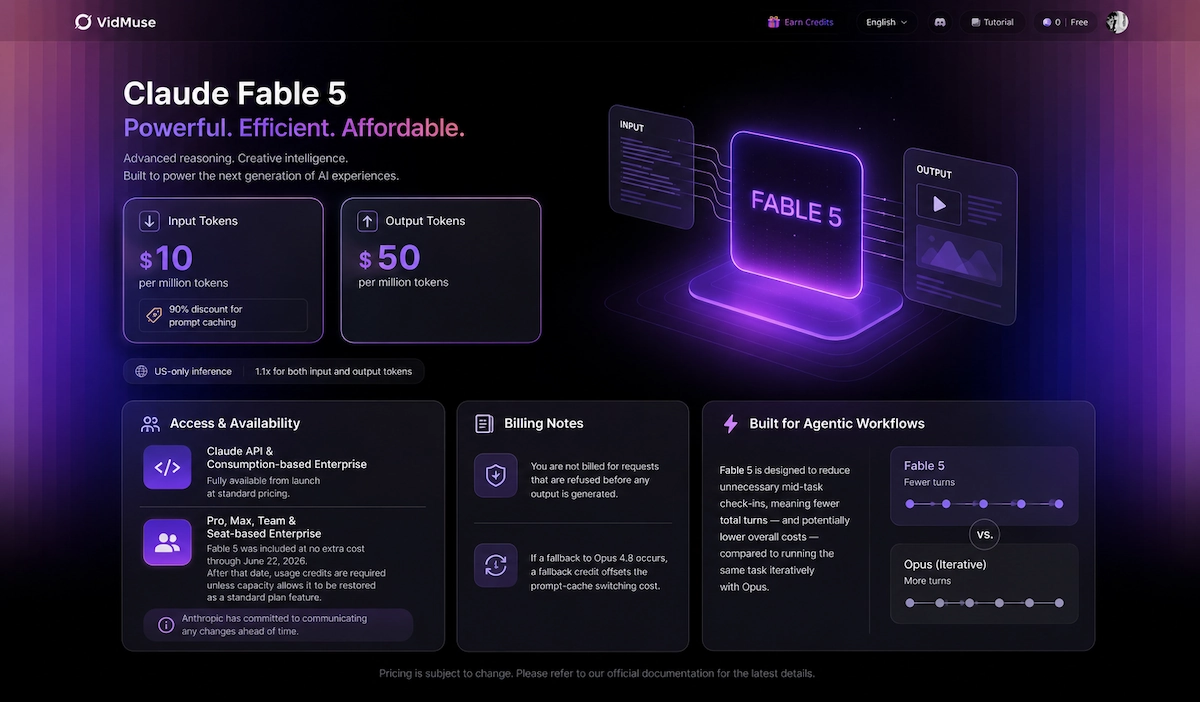
Claude Fable 5 is priced at $10 per million input tokens and $50 per million output tokens — less than half the cost of Claude Mythos Preview. The existing 90% input token discount for prompt caching applies. For workloads requiring US-only inference, pricing is 1.1x for both input and output tokens.
Access depends on how you use Claude:
- Claude API and consumption-based Enterprise plans: Fully available from launch at standard pricing.
- Pro, Max, Team, and seat-based Enterprise plans: Fable 5 was included at no extra cost through June 22, 2026. After that date, usage credits are required unless capacity allows it to be restored as a standard plan feature. Anthropic has committed to communicating any changes ahead of time.
- Billing note: You are not billed for requests that are refused before any output is generated. If a fallback to Opus 4.8 occurs, a fallback credit offsets the prompt-cache switching cost.
For teams running large-scale agentic workflows, the token efficiency matters. Fable 5 is designed to reduce unnecessary mid-task check-ins, meaning fewer total turns — and potentially lower overall costs — compared to running the same task iteratively with Opus.
Claude Fable 5 in Claude Code
Claude Fable 5 is the most capable model for ambitious coding work in Claude Code, and it was designed with agentic use precisely in mind.
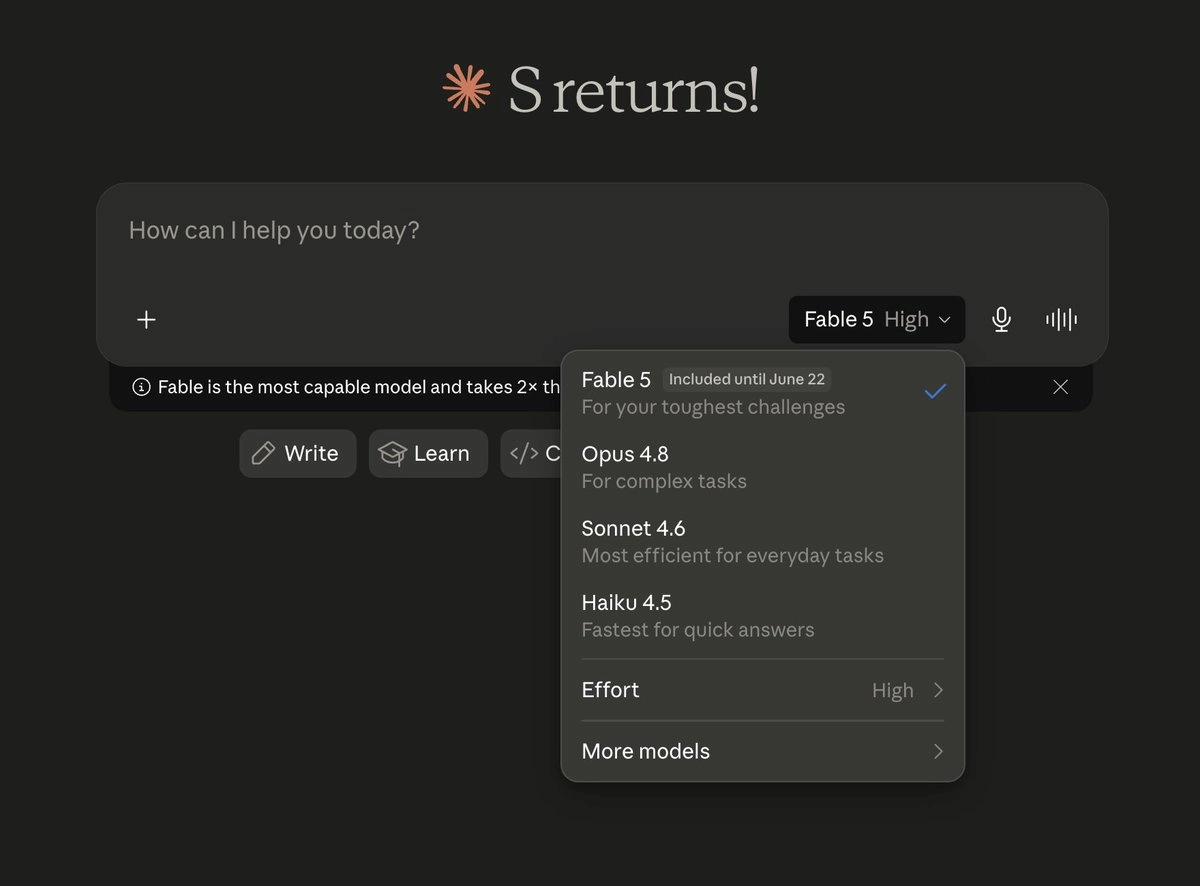
In Claude Code, Fable 5 can:
- Execute multi-day autonomous coding sessions without repeated user check-ins
- Plan migrations across large codebases, delegate to sub-agents, and track its own progress
- Write its own tests to verify correctness
- Use vision to check that implemented designs match their specifications or mockups
- Handle large refactors, complex implementations, and cross-system integrations
Using claude-fable-5 via the Claude Code interface:
Confirm access
Ensure you're on a paid plan with Fable 5 access through API or Enterprise consumption-based billing.
Select the model
Choose Claude Fable 5 from the model picker in Claude Code.
Describe the outcome
Give Fable 5 the result you want so it can plan the steps autonomously.
Pair with agents
For agentic sessions, pair with Claude Managed Agents for full multi-stage delegation.
Tune effort
Use the effort parameter to control thinking depth: lower for speed, higher for harder problems.
- Ensure you're on a paid plan with Fable 5 access (API or Enterprise consumption-based).
- Select Claude Fable 5 from the model picker in Claude Code.
- Describe the outcome you want — Fable 5 plans the steps autonomously.
- For agentic sessions, pair with Claude Managed Agents for full multi-stage delegation.
- Use the effort parameter to control thinking depth: lower for speed, higher for harder problems.
Important API behaviors specific to Fable 5 and Mythos 5:
- Adaptive thinking is always on. You cannot disable thinking with
thinking: {"type": "disabled"}. Use theeffortparameter to adjust depth. - Raw chain-of-thought is never returned. Set
display: "summarized"to receive readable summarized thinking. - Refusals return HTTP 200, not errors. The response includes
stop_reason: "refusal"and identifies which classifier declined the request.
Claude Fable 5 vs Opus 4.8: When to Use Which
The right choice between Fable 5 and Opus 4.8 depends on task duration, autonomy needs, and whether your work touches the domains covered by Fable's classifiers.
Claude Fable 5
Best for
- Long multi-stage tasks
- Autonomous execution
- Large migrations
- Vision-based validation
Watch out
- Conservative classifiers
- Higher capacity use for routine work
Claude Opus 4.8
Best for
- Live back-and-forth sessions
- Biology or security work
- Focused deep reasoning
- Faster iteration
Watch out
- Less oriented around multi-day autonomous execution
Use Claude Fable 5 when:
- The task is long, multi-stage, and benefits from autonomous execution with fewer check-ins
- You're working on large migrations, complex implementations, or outputs from dense documents
- Vision is needed to validate work against a design or goal
- You'd rather describe the outcome and let the model plan the steps
- You've tested with Opus and hit a ceiling
Use Claude Opus 4.8 when:
- You're working in a live, back-and-forth session where you want each answer sooner
- Your work directly involves biology, cybersecurity, or chemistry — Fable routes these to Opus anyway, so starting with Opus is more direct
- Deep, focused reasoning is needed without the overhead of extended autonomous execution
- You're on a session where faster iteration matters more than long-horizon planning
One practical note from Anthropic's own guidance: for biology and security work, starting with Opus 4.8 is simpler, since Fable's classifiers will redirect those queries there regardless.
Claude Fable 5 and Claude Mythos 5: What's the Difference?
Fable 5 and Mythos 5 share the same underlying model — the difference is the safeguards.
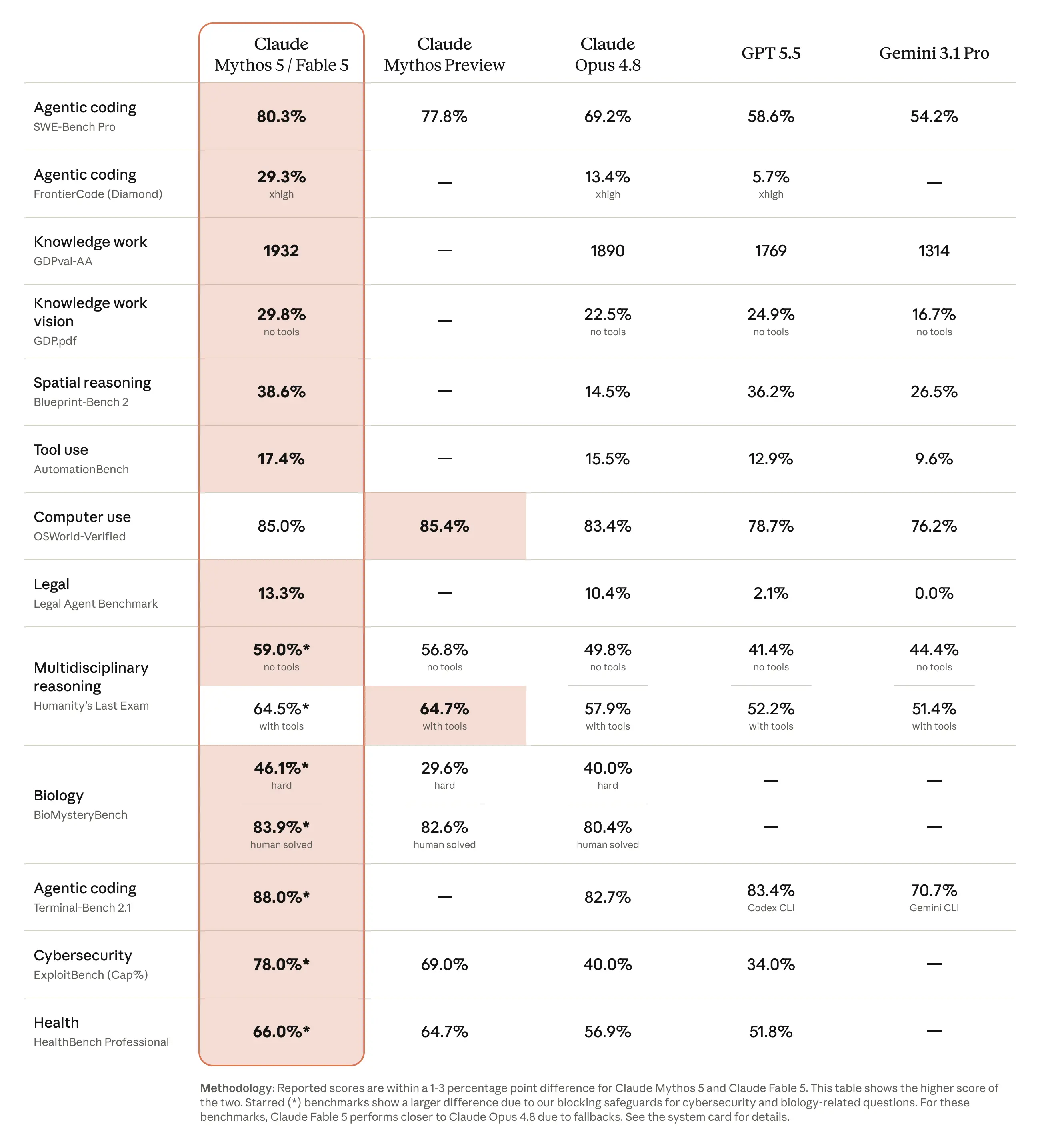
Mythos 5 has cybersecurity safeguards lifted (and soon, biology safeguards for approved researchers). Fable 5 has those classifiers active, meaning requests in those domains fall back to Opus 4.8. The name distinction reflects this: fable (that which is told) and mythos (myth, from Greek) are near-synonyms chosen deliberately to signal that the models are the same story, with different access controls applied.
Availability:
- Claude Fable 5: Generally available on the Claude API, Claude Platform on AWS, Amazon Bedrock, Vertex AI, and Microsoft Foundry. API model ID:
claude-fable-5. - Claude Mythos 5: Restricted to Project Glasswing partners (cyber safeguards lifted) and, soon, select biology researchers (biology/chemistry safeguards lifted). API model ID:
claude-mythos-5. Not publicly available.
Both models require 30-day data retention for safety monitoring and are designated as Covered Models. Zero data retention is not available for either.
Safety Classifiers and Fallback Behavior
Fable 5's safety classifiers are the mechanism that makes a Mythos-class model safe for general release. They cover three domains:
1. Cybersecurity.
Fable 5's classifiers block both exploit development and broader offensive cyber tasks. External red-teaming produced no universal jailbreaks in over 1,000 hours of testing, and one external partner found Fable 5's cyber safeguards were the most robust of any model tested, with zero compliance on harmful single-turn cyberattack requests even when using 30 different public jailbreak techniques.
2. Biology and chemistry.
Given Mythos-class models' demonstrated ability to reason through advanced biological tasks — including outperforming dedicated protein language models on viral shell assembly prediction — Fable falls back to Opus 4.8 on most biology and chemistry requests. This is intentionally conservative and will be narrowed as the trusted access program for biology researchers matures.
3. Distillation.
Requests flagged as attempts to extract Fable 5's capabilities to train competing models are redirected to Opus 4.8.
Key practical facts:
- More than 95% of Fable 5 sessions involve no fallback at all.
- Users are informed whenever a fallback occurs.
- Fallback requests are not billed at Fable prices.
- Fallback handling can be automated via the
fallbacksparameter (beta on Claude API and Claude Platform on AWS) or via SDK middleware (TypeScript, Python, Go, Java, C#).
How to Access the Claude Fable 5 API
Getting started with the Claude Fable 5 API requires a paid Anthropic plan and use of the model ID claude-fable-5.
Step-by-step:
- Set up API access via the Claude Platform or a supported cloud: Amazon Bedrock, Vertex AI, or Microsoft Foundry.
- Use the model ID
claude-fable-5in your API calls. - Handle refusals correctly: Fable 5 refusals return
stop_reason: "refusal"as a successful HTTP 200, not a 4xx error. Build handling logic for this. - Implement fallback using the
fallbacksparameter (beta) or SDK middleware if your use case touches domains Fable's classifiers cover. - Use the
effortparameter to tune thinking depth and cost. The default is appropriate for most work; reserve maximum effort for the hardest problems. - For long-context prompts, review Anthropic's Fable-specific prompting guidance — structure differs slightly from Opus or Sonnet for very long inputs.
For teams migrating from Claude Opus 4.8, Anthropic has published a dedicated migration guide. For teams coming from Claude Mythos Preview, a separate migration path covers the specific API changes between those model versions.
Claude Fable 5 for Creative and Multimodal Work
Claude Fable 5's vision capabilities open up applications well beyond code, including dense document work in finance, legal, analytics, and architecture.
Its ability to understand diagrams, charts, and tables nested in PDFs makes it particularly useful for:
- Extracting and interpreting data from complex financial or scientific figures
- Processing long technical documents with mixed text and visual content
- Validating that a generated output matches an original design specification
This vision-plus-reasoning combination is relevant for any creator working with rich media briefs, mood boards, storyboard validation, or visual-first production workflows.
Claude Fable 5 for Music Video and Long-Horizon Creative Production
For indie musicians and content creators who work at the intersection of AI models and visual production, Fable 5's capacity for long-horizon, multi-stage creative tasks represents a meaningful shift.
The challenge with AI-assisted creative production has never been generating a single shot — it's been sustaining coherent creative intent across a full project. Fable 5's ability to plan across stages, check its own work, and use vision to validate outputs against goals maps directly onto what serious music video production requires: a brief, a storyboard, and consistent execution across scenes.
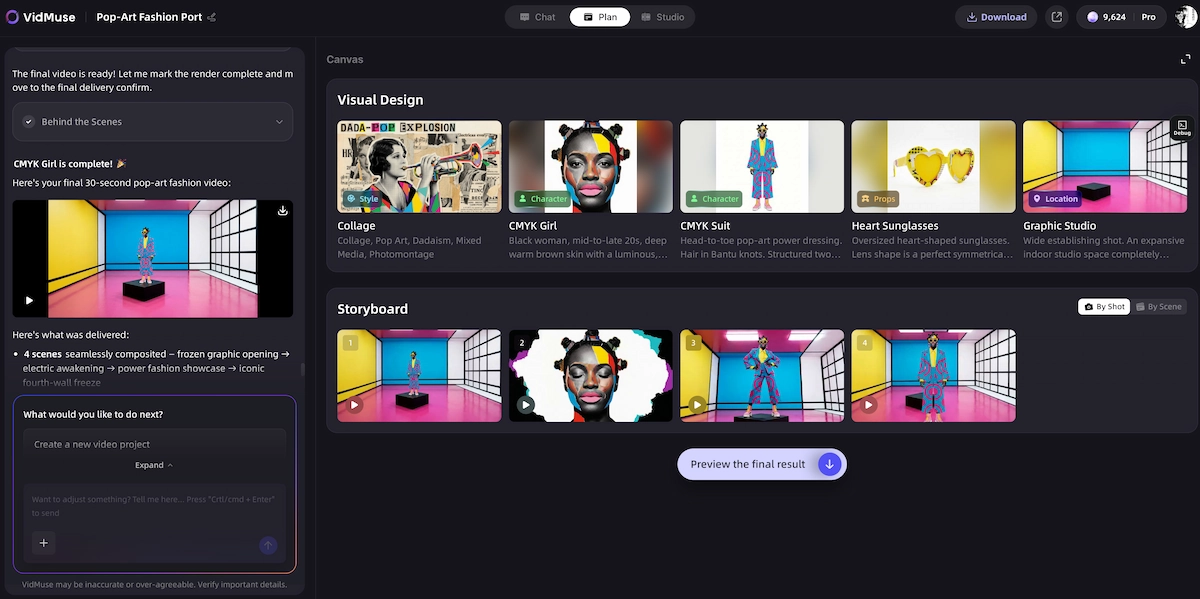
VidMuse is built specifically for this kind of work. As an AI Director platform for music video production, VidMuse structures the full production workflow — Creative Brief → Reference Generation → Scene & Shot List → Storyboard → Video Generation — using agent-based logic that plans the full MV rather than executing isolated one-shot prompts. The platform integrates models including Seedance 2.0, Kling V3.0 Pro, Veo 3.1, and Hailuo 2.3 Pro, alongside Suno AI for original track generation, so musicians can go from song to complete visual without leaving the platform.
Create Your AI Video in Minutes
Turn your idea into a video with VidMuse.
VidMuse 2.0's Shot Refine by Quoting and Timeline Editor give creators precise control over how scenes are refined — analogous to the kind of feedback loop that Fable 5 applies to its own coding outputs. For indie artists who want studio-level visual production at accessible cost, VidMuse's AI Director approach is the practical equivalent of what Fable 5 brings to engineering: describe the outcome, let the system plan the steps.
Common Mistakes When Using Claude Fable 5
Using Fable 5 for tasks that Sonnet handles just as well is the most common and costly mistake. Because Fable uses the most of your rate limit, applying it to routine writing, debugging, or summarization burns capacity without improving output.
Other mistakes to avoid:
- Ignoring refusal handling in your integration. Refusals return HTTP 200, not errors. If your error handling only catches 4xx/5xx, refusals will silently produce empty outputs.
- Not implementing fallback logic. If your workflow touches biology, cybersecurity, or chemistry, build fallback handling or use the SDK middleware — don't let fallbacks break your pipeline.
- Disabling thinking on Fable 5. The
thinking: {"type": "disabled"}parameter is not supported. Attempting to set it will cause issues. Use theeffortparameter instead. - Expecting raw chain-of-thought output. Raw thinking is never returned by Fable 5 or Mythos 5. Set
display: "summarized"if you want readable reasoning traces. - Starting with Fable for biology or security work. Fable's classifiers will redirect these to Opus 4.8 anyway. Start with Opus for live back-and-forth sessions in those domains.
- Assuming post-June 22 subscription access. Fable 5 moved to usage credits for subscription plans after June 22. Budget accordingly.
FAQ
What is Claude Fable 5?
Claude Fable 5 is Anthropic's most capable model made available for general use, released June 9, 2026. It's a Mythos-class model — the same underlying model as Claude Mythos 5 — built for long-horizon, complex, and agentic tasks including large-scale coding, document-heavy knowledge work, and multi-stage autonomous workflows.
What is Claude Fable 5 pricing and cost?
Claude Fable 5 is priced at $10 per million input tokens and $50 per million output tokens, with the existing 90% discount for prompt caching. US-only inference is available at 1.1x pricing. Through June 22, 2026, Fable 5 was included on paid subscription plans at no additional cost; after that, usage credits are required.
How do I use Claude Fable 5 in Claude Code?
Select `claude-fable-5` from the model picker in Claude Code. Fable 5 supports multi-day autonomous coding sessions, self-generated tests, and vision-based output validation. Use the `effort` parameter to control thinking depth. Note that adaptive thinking is always on — you cannot disable it, but you can adjust depth.
What's the difference between Claude Fable 5 and Claude Mythos 5?
Both share the same underlying model. The difference is safeguards: Fable 5 has safety classifiers active for cybersecurity, biology/chemistry, and distillation, routing those requests to Opus 4.8. Mythos 5 has those safeguards lifted in some areas and is currently restricted to Project Glasswing partners and select biology researchers — it's not publicly available.
How does the Claude Fable 5 fallback system work?
When Fable 5's classifiers flag a request, the API returns a successful HTTP 200 with `stop_reason: "refusal"` rather than an error. The request can then be automatically retried on Claude Opus 4.8 using the `fallbacks` parameter or SDK middleware. You are not charged Fable prices for refused requests, and a fallback credit offsets prompt-cache switching costs. Over 95% of sessions see no fallback.
What are Claude Fable 5 benchmarks compared to other models?
Fable 5 is state-of-the-art on nearly all tested benchmarks at launch, including the highest score on Hebbia's Finance Benchmark, top performance on Cognition's FrontierCode evaluation, and best-in-class results for vision tasks. On agentic coding tasks, Stripe reported it compressed two months of engineering work into a single day on a 50-million-line codebase.
Is Claude Fable 5 available on Reddit, and what is the community saying?
The official Fable 5 announcement on r/ClaudeAI received significant engagement. A notable thread raised concerns about access inequality — arguing that the Fable/Mythos split creates a tiered system where public users get the safety-constrained version while governments and institutions access fuller capabilities. Anthropic has acknowledged the conservative tuning of current safeguards and committed to reducing false positives over time.
Conclusion
Claude Fable 5 represents a meaningful step forward — not just in benchmark performance, but in the kind of work AI can reliably sustain. For developers, it's the most capable model available via the Claude API, purpose-built for long-horizon coding and agentic workflows. For enterprises, it handles complex knowledge work with minimal oversight. For builders working on AI-powered products, it brings Mythos-class reasoning to general availability at accessible pricing.
The tradeoffs are real: conservative safety classifiers will occasionally redirect requests, subscription access shifted to usage credits after June 22, and Mythos 5 with lifted safeguards remains gated. Understanding these constraints upfront is what separates a smooth integration from a frustrating one.
If you're building AI-powered creative workflows — especially music video production or long-form visual content — tools that match Fable 5's planning depth on the creative side are worth knowing. VidMuse is purpose-built for exactly this: agent-based production logic that takes a creative brief all the way to a finished music video, with the same principle Fable 5 applies to engineering — describe the outcome, let the system plan the steps.
→ Explore VidMuse's AI Director workflow → Start with the VidMuse guide to AI music video production
Create Your AI Video in Minutes
Turn your idea into a video with VidMuse.

Written By
VidMuse Team
Continue Reading
Latest blog posts related to AI video creation.
PixVerse V6 x VidMuse AI: Model Guide and Video Workflow
PixVerse V6 review and VidMuse integration guide. Capabilities, 15s 1080p video, prompt tips, model comparison, pricing, and how to use V6 in VidMuse workflows.
FLUX 3: What It Is, Capabilities, and How to Access It
FLUX 3 is Black Forest Labs' multimodal AI model for image, video, audio, and action. Full guide: capabilities, FLUX 3 vs FLUX 2, availability, and pricing.

Free Music Visualizer: 10 Best Free Tools in 2026
Compare 10 best free music visualizers in 2026. Waveform tools, AI music video makers, watermark policies, export limits, and which tool fits your workflow.